impressions and reflections from my Brazil trip in October-November 2025.
published on PITCH blog.
COP summits resemble the global equivalent of converging on the village square while the village is on fire: ineffective, procedural and frequently deadlocked, yet still one of the few places where movements, governments, corporations and institutions confront one another over how planetary futures are narrated and negotiated. Cultural institutions seize these moments eagerly. Some develop public programmes aimed at local audiences, others position themselves as stages for international climate discourse and future-making.
On my way to COP30 in Belém, I encountered a dense landscape of climate exhibitions, ecological imaginaries and transition narratives. Some exhibitions sought to communicate climate collapse more effectively through data, immersion and behavioural pedagogy. Others attempted something more radical: reorganising relations between humans and more-than-human life. Yet one contradiction kept returning. The deeper the ecological critique, the harder it became to separate it from the fossil infrastructures underwriting contemporary culture itself.
São Paulo: Historicising ecology
São Paulo presented itself as the most globally integrated node of Brazilian cultural infrastructure: financial capital, art-market hub and sprawling metropolis of museums, foundations and biennials simultaneously addressing elite international audiences and mass urban publics.
At MASP, Histórias da Ecologia was among the clearest and most politically coherent exhibitions I encountered during my journey. The exhibition framed ecology not as a neutral environmental concern but as a terrain of conflict over land, labour and life. It explicitly named capitalism, colonialism, racism and patriarchy, and situated the environmental breakdown within the violent histories of empire, extraction and dispossession. The exhibition unfolded through sections titled Web of Life, Geographies of Time, On Becoming, Territories, Migrations and Borders and Inhabiting the Climate. Artworks and artifacts narrated stories of territory, memory and survival. Indigenous resistance against dams and mining projects sat alongside critiques of agribusiness, industrial pollution and developmentalism.
Elsewhere in MASP, exhibitions by Clarissa Tossin and Abel Rodríguez extended these concerns through more situated artistic and cosmological perspectives. Tossin’s work examined extractive modernity through diasporic and infrastructural lenses, while Rodríguez — an internationally recognised Indigenous knowledge-holder from the Colombian Amazon — brought forest memory, ecological observation and non-Western temporalities into direct dialogue with contemporary art institutions.
Notably, unlike several other institutions I encountered during this journey, MASP’s ecology programming did not foreground obvious fossil or mining sponsorships. Whether this reflects greater institutional autonomy, different funding structures or simply less visible entanglements, the contrast with the 36th Bienal de São Paulo was immediate. Here, the rhetoric of decoloniality, plurality and Indigenous cosmology circulated everywhere, but often in strangely weightless ways. The Bienal was not devoid of meaningful work; but unlike MASP’s ecology exhibition, it often struggled to convert curatorial gestures into structural critique. Its politics remained diffuse, performative and institutionally absorbable.
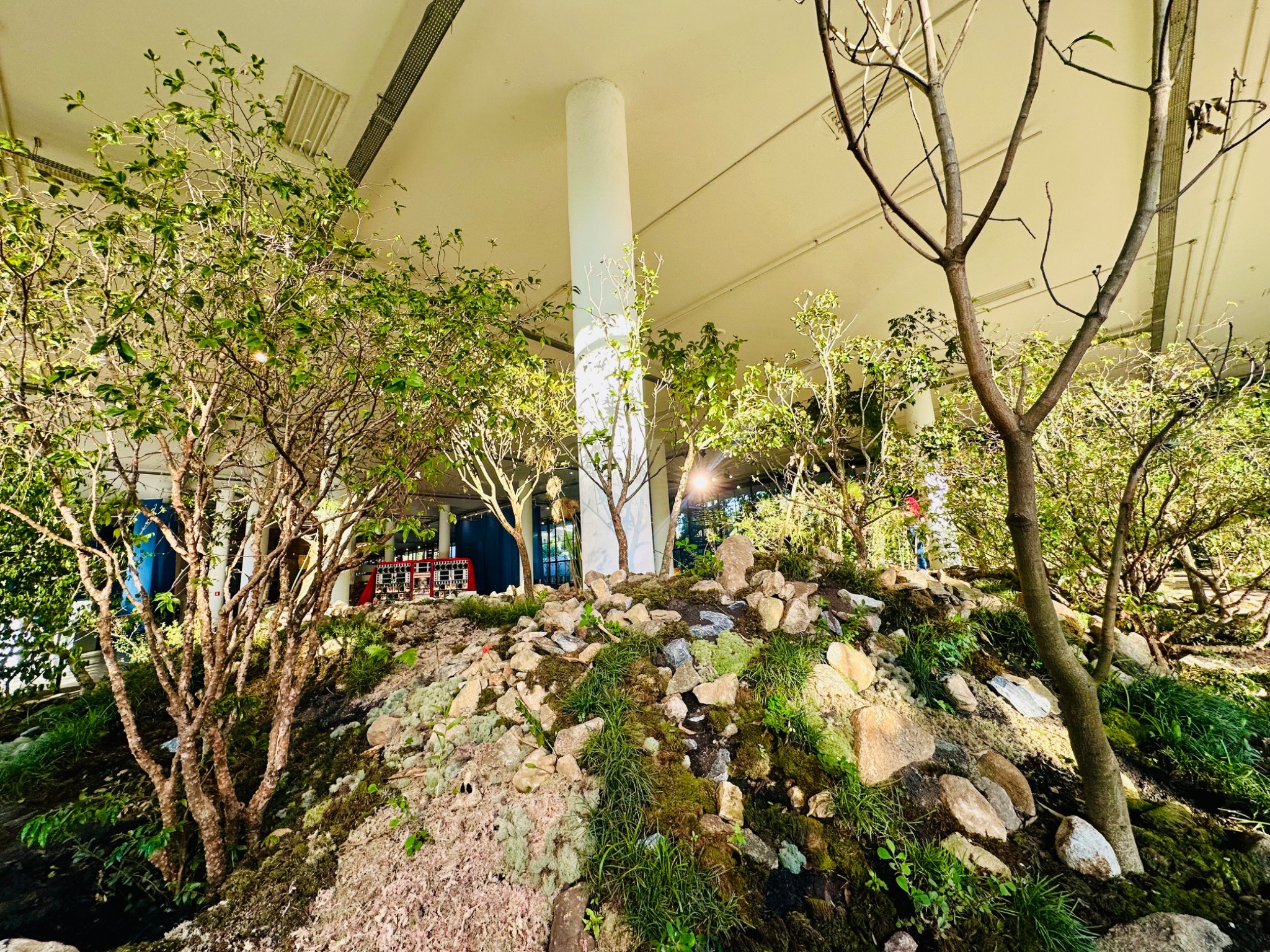
Perhaps this is due to the Bienal’s sponsorship structure, which includes Petrobras and Vale — fossil fuel and mining multinationals deeply entangled with Brazil’s extractivist development model. Introducing the Bienal, Petrobras claims “culture is also our energy”, and Vale states “Where there is culture, Vale is there”. The contradiction is not concealed but metabolised into the institution itself; decolonial discourse coexisting comfortably with petrocultural infrastructure. The result was a recurring sensation familiar across the global art world: institutions enthusiastically adopting the language of ecological and decolonial transformation while remaining materially embedded within extractive economies.
Rio de Janeiro: Fossil futurism
In Rio de Janeiro, these tensions became even more visible at the Museu do Amanhã (“Museum of Tomorrow”), the spectacular Calatrava-designed science museum built as part of the Porto Maravilha redevelopment project ahead of the 2016 Olympics. Framing itself as a museum not of history but of the future, the institution evokes the universalist ambitions of twentieth-century world exhibitions: science, innovation and planetary destiny condensed into an immersive architectural spectacle.
The museum’s permanent exhibition designed by Ralph Appelbaum Associates unfolds across five sections: Cosmos, Earth, Anthropocene, Tomorrow and Us. At first glance, the experience appears ambitious and sophisticated: immersive projections, climate visualisations, speculative futures and interactive installations guiding visitors through humanity’s planetary condition.
But the deeper I moved through the exhibition, the more striking its absences became. The environmental breakdown was repeatedly framed as a challenge for “humanity” in general, detached from the imperial histories and sacrifice zones. The Anthropocene appeared as a species-level condition rather than a differentiated political project driven by colonial extraction, industrial modernity and unequal consumption:
The use of fossil fuels over the last 150 years has revolutionized human existence. Today we are more numerous, more prosperous, and we live longer because we have learned to use energy extracted from the depths of the Earth.
This framing presents fossil modernity as a collective civilisational achievement while avoiding the questions of differentiated agencies, benefits and impacts. Planetary crisis becomes an unfortunate side-effect rather than the inevitable consequence of a world-system. The installation transforms fires, floods and planetary data into overwhelming audiovisual spectacle. Yet precisely through this abstraction, politics disappears: no legal frameworks, no multinational corporations, no colonial histories — only “humanity” confronting its geological footprint.
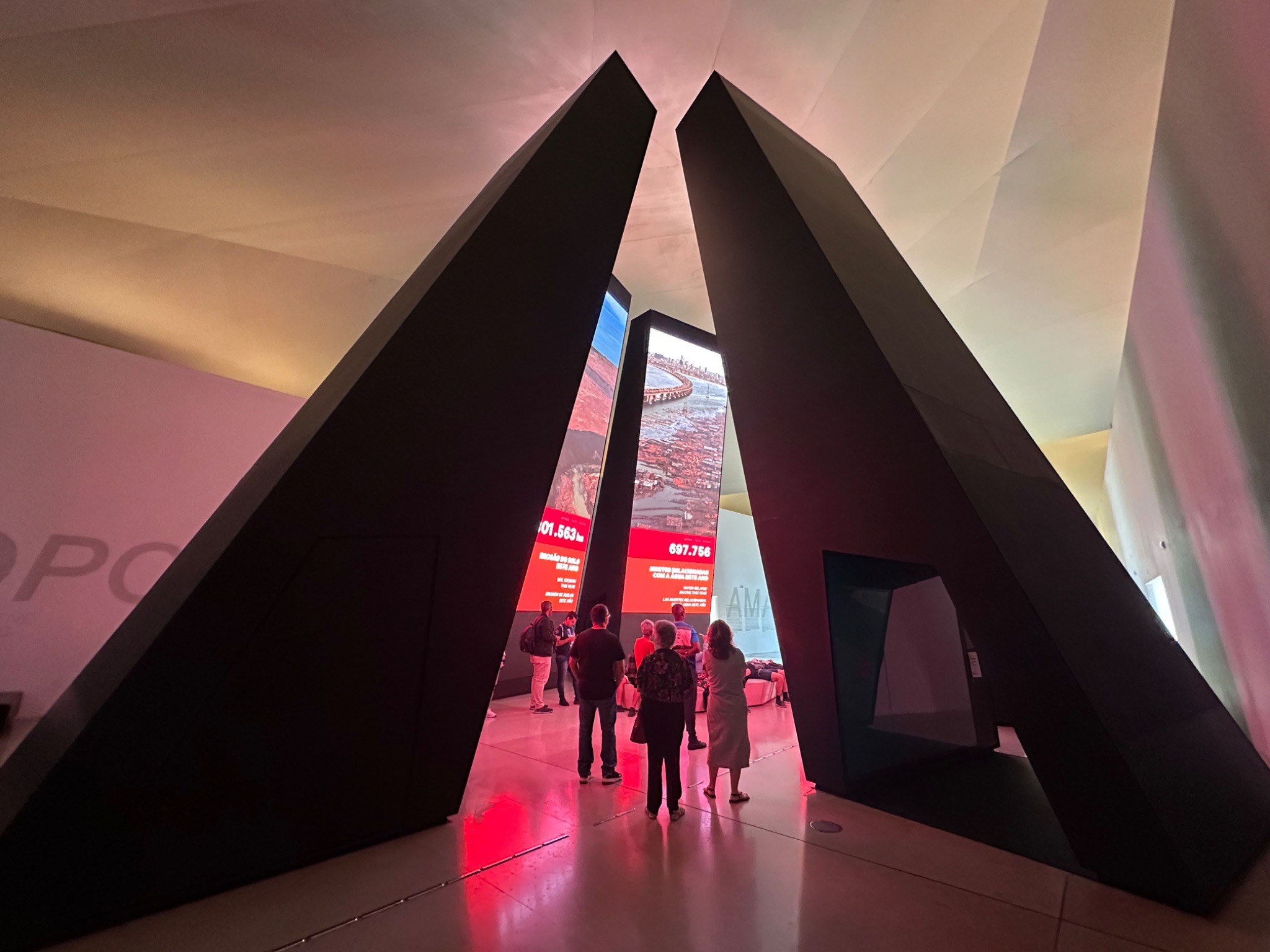
Here too, the curatorial framing reflects the funding structure. Shell and Vale are not peripheral donors but institutional maintainers helping shape the museum’s narrative. The result is a familiar form of a dehistoricised and depoliticised environmental pedagogy: acknowledging planetary crisis while carefully avoiding naming fossil power. It reproduces petrocultural aesthetics: sleek, immersive and technologically seductive, yet profoundly unwilling to confront the political economy of fossil modernity.
The museum’s techno-optimism intensified this dynamic. Especially revealing was the temporary pop-up exhibition Experiência Lumisphere: Como Você Imagina o Futuro? (“Lumisphere Experience: How Do You Imagine the Future?”), installed in geodesic domes outside the museum. Visitors were invited to respond to future speculation prompts that produced AI-generated slop — a kitsch stream of frictionless futurist imagery of smart cities, green skylines, glowing forests and algorithmically generated utopias.
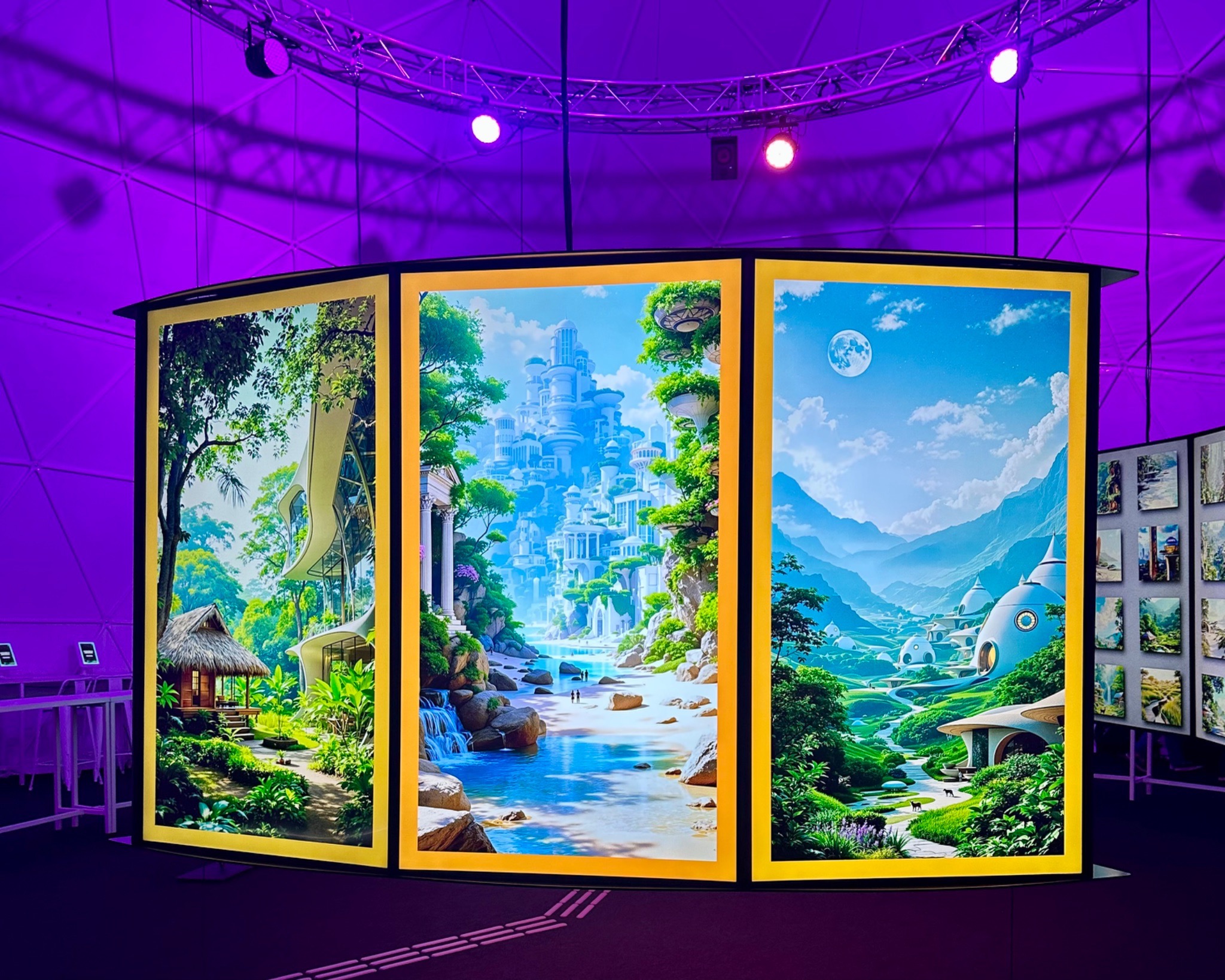
Any reflection on the material infrastructures underpinning contemporary AI systems was entirely absent: nothing on data centres, energy demand, water consumption, rare-earth extraction, platform monopolies and accelerating computational emissions. In a museum supposedly dedicated to planetary futures, the lack of ecological accountability around generative AI felt astonishing. This exhibition seemed better suited to a Museum of No Tomorrow.
Brasília: Technocratic transitions
Brasília is a powerful symbol of nation building, monumental modernity, planned urbanism and petromobility. Oscar Niemeyer’s architecture still projects futurity and optimism, even as many of the city’s cultural institutions feel strangely underused and suspended in bureaucratic time.
At SESI Lab — an interactive science and technology museum — I visited Clima: O Novo Anormal (“Climate: The New Abnormal”), originally developed by the French public science institution Universcience and adapted to Brazilian contexts with local statistics, references and materials. Unlike Museu do Amanhã, the exhibition directly names fossil fuels and climate collapse. Visitors are guided through the mechanics of global warming, petrochemical dependence and energy systems in a pedagogical style that is rational, explanatory and scientifically authoritative.
Unlike many corporate sustainability narratives, the exhibition does not deny the centrality of fossil dependency. It openly addresses petrochemical infrastructures and carbon lock-in. It repeatedly insists on urgency. One panel bluntly states: “We need to eliminate oil from our lives — but it’s hard! … Every day, you wake up and go to sleep surrounded by petroleum products.”
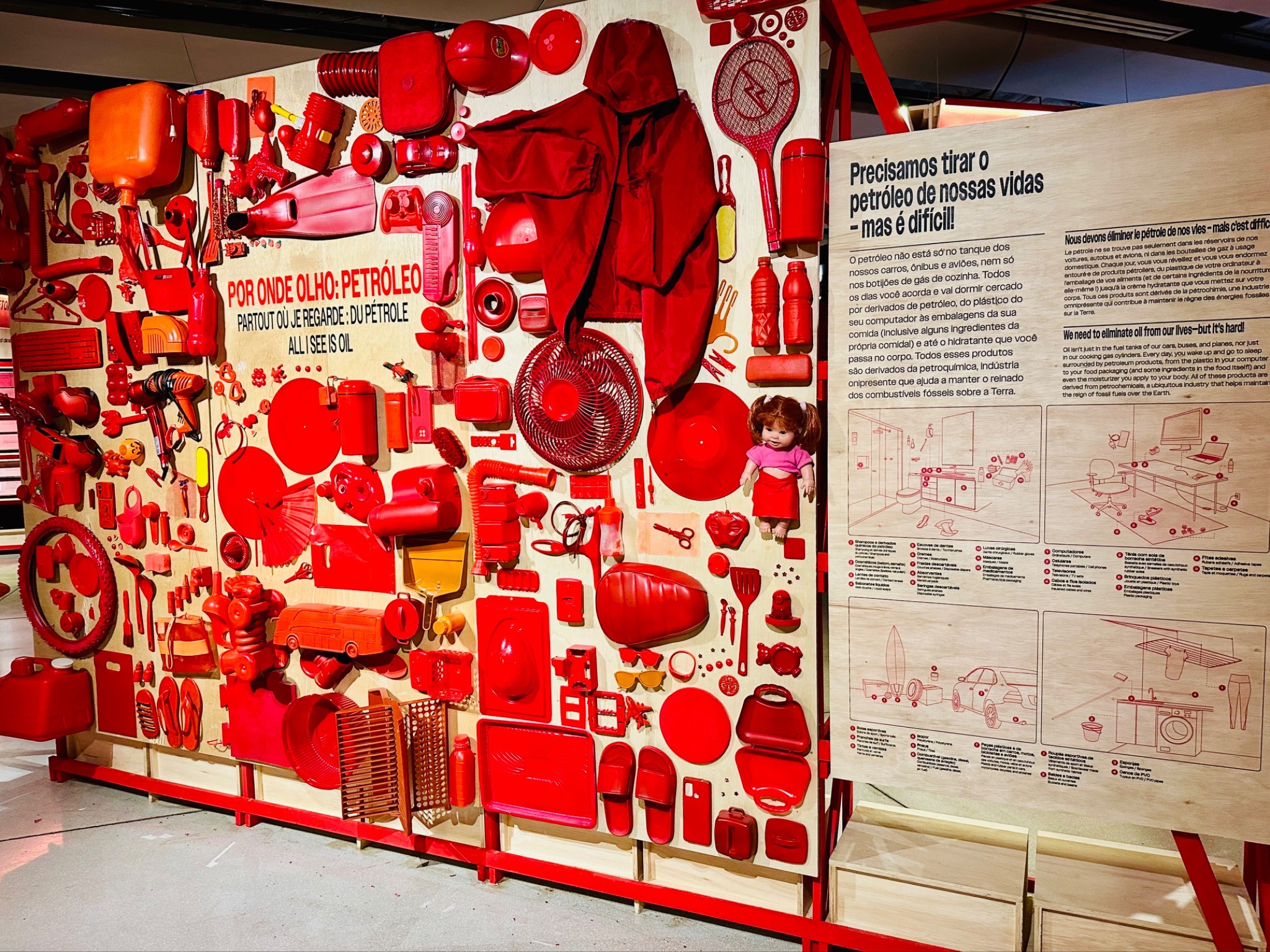
Yet despite this relative clarity, the exhibition remained firmly embedded within a conventional climate-communication framework: awareness-raising, behavioural change and technocratic transition management. The visitor is addressed primarily as a rational climate subject who must become informed, responsible and adaptive. The repeated vocabulary is revealing: innovation, responsibility, sustainability, transition, decarbonisation.
Even the exhibition’s material design reinforced this institutional logic. The travelling exhibition was developed according to principles of ecodesign and circularity, using recycled and locally sourced materials in modular structures. These choices matter (especially compared to the disposable scenography common in large-scale exhibitions and expos), but ecological responsibility here remained largely operational and managerial rather than political.
The exhibition often felt drowned in statistics and explanatory panels. The planetary crisis became a problem of governance, literacy and optimisation. This is climate pedagogy in its dominant contemporary form: scientifically literate, institutionally responsible and operationally sustainable — yet politically moderate and fundamentally technocratic. Unsurprisingly, Shell appears again here as an educational partner disseminating corporate energy transition narratives. The result is a strange double movement: fossil dependency is openly acknowledged, whereas how to deal with that dependency is told by fossil capital itself.
Belém: Listening to the Earth
Belém initially feels almost otherworldly through its humidity, vegetation and cuisine — yet in reality it may be the worldliest of my journey. During COP30, Belém became an intense and contradictory convergence point of official diplomacy, movement organising and ecological spectacle. The Blue Zone often felt sterile and over-securitised, while the counter-summit and community spaces across the city felt far more politically alive. The city’s cultural landscape became impossible to map comprehensively. Exhibitions and performances spread across FreeZone Cultural Action, Amazon Biennial, Caixa Cultural, Centro Cultural Banco da Amazônia and Museu das Amazônias, alongside countless musical and community-led events.
The most powerful exhibition I encountered came at the Pará State Museum: Você Já Escutou a Terra? (“Have You Ever Listened to the Earth?”), part of the Museu da Pessoa (Museum of the Person) by Karen Worcman. It was co-curated by Ailton Krenak, one of Brazil’s most important Indigenous thinkers, writers and environmental activists, who has spent decades challenging developmentalism, extractivism and anthropocentrism while articulating Indigenous philosophies of interdependence, plurality and ecological reciprocity.
The exhibition immediately felt different from everything that preceded it. Modest in scale and handcrafted in materiality, it relied on testimony, listening, participation and embodied encounters rather than spectacle or data visualisation. First, the Earth’s Crust, a massive installation woven by hundreds of people from waste fabrics and plastics, served both as sound sculpture and sanctuary. Then the River of Memories presented a series of oral testimonies and territorial memories gathered through the Museu da Pessoa archive spanning 35 years.
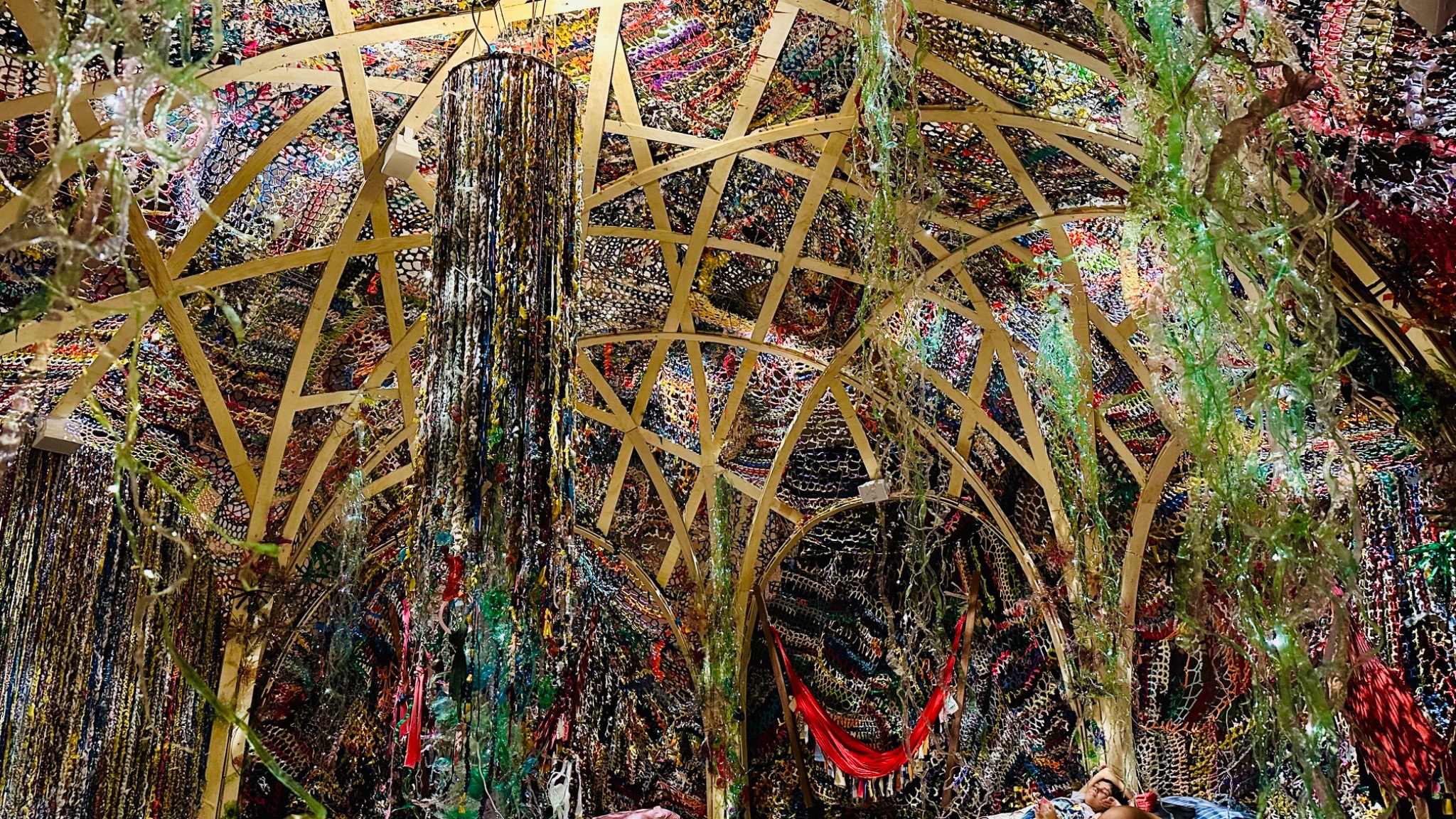
Krenak’s curatorial proposition was not to explain the climate collapse, but to transform the visitor’s relation to the world itself: “We need to move humans out of this place of consuming the planet, and evolve toward a biocentric movement: the idea of being on Earth along with the Earth, not just on top of its body.” Against anthropocentrism, ownership and consumerism, the exhibition proposed listening as political and cosmological practice of attending to rivers, forests, memories and non-human presences.
It would be tempting to position Você Já Escutou a Terra? as a clean counterpoint to previous exhibitions. Unlike the techno-solutionism of Museu do Amanhã or the managerial pedagogy of O Novo Anormal, Krenak’s exhibition proposes not better climate management, but a profound reorganisation of how humans relate to territory, to each other and to more-than-human life.
Yet even here, the same petrocultural entanglements reappeared. The exhibition’s main sponsor is Petrobras, which presents its support as part of a “commitment to initiatives that honor intangible heritage, foster dialogue between different knowledge systems, and bring visibility to the experiences that shape Brazil.” This contradiction cannot simply be dismissed as incoherence or reduced to greenwashing. Petrobras appears not only as a fossil corporation seeking reputational legitimacy, but as a structuring force within Brazilian cultural production itself: simultaneously extractive company, state-development project, transition actor and national cultural patron.
What emerged across these exhibitions was therefore not a simple opposition between compromised institutions and radical ecological critique. Rather, ecological critique increasingly operates inside institutions funded by extraction itself. Fossil capital no longer finances only denial; it finances transition discourse, Indigenous visibility, ecological pedagogy and future speculation. The question, then, is no longer whether culture can remain untouched by fossil capital. It is whether genuinely transformative ecological politics can still emerge from within institutions so deeply shaped by petromodernity.
Brazil: Petro-nature-cultures
Predictably, Brazil’s COP presidency produced no major breakthrough. Fossil fuels remained absent from official outcomes, despite escalating planetary urgency. Even the relative withdrawal of the United States failed to significantly rebalance climate geopolitics. Yet other developments suggested emerging fractures within the dominant climate regime. The long-demanded Just Transition framework finally gained greater institutional recognition, while the Fossil Fuel Non-Proliferation Treaty initiative — driven significantly by Colombia and supported by dozens of countries — continued consolidating fossil phaseout itself as an explicit political horizon.
Brazil’s cultural institutions mirrored these tensions. What the exhibitions ultimately revealed was not simply hypocrisy, but the extraordinary adaptive capacity of petroculture. Fossil capital no longer legitimises itself primarily through denial. Petrobras funds Indigenous memory projects. Shell sponsors climate pedagogy. Mining corporations underwrite ecological discourse. Ecological critique increasingly operates within institutions materially sustained by extraction.
Yet important differences remain. Museu do Amanhã transforms planetary crisis into depoliticised spectacle and techno-futurist management. O Novo Anormal offers a more honest but still technocratic pedagogy of adaptation and behavioural change. The Bienal oscillates ambiguously between critical gesture, institutional absorption and extractive sponsorship. By contrast, MASP’s Histórias da Ecologia and Krenak’s Você Já Escutou a Terra? insist that climate collapse cannot be separated from colonialism, extraction and capitalism itself — and that ecological transformation requires more than technological transition; it demands fundamentally different ways of inhabiting the earth.
In the shadow of COP30, these exhibitions made clear that the struggle over climate futures is also a struggle over culture: over who gets to narrate the crisis, under what material conditions, and in whose interests. The influence of petrocultures appears inescapable. And yet Krenak affirms:
The Earth has answers for us all. And we are the Earth’s answer.
 Selçuk Balamir
Leave a comment