Interview published in Winq, December 2023.
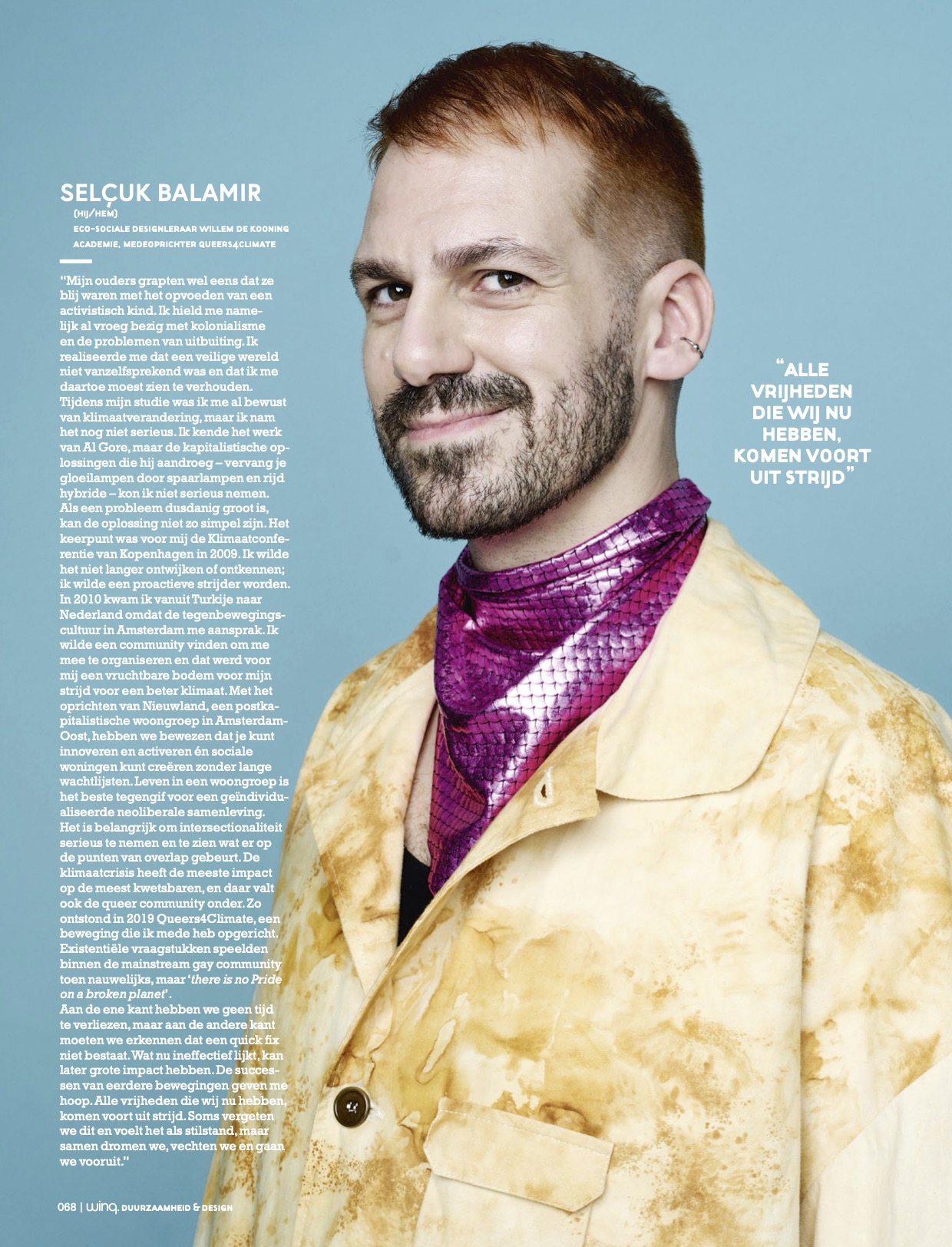
My parents sometimes joked that they were happy to raise an activist child. In fact, I was concerned early on with colonialism and the problems of exploitation. I realised that a safe world could not be taken for granted and that I had to relate to it. During my studies, I was already aware of climate change, but I did not yet take it seriously. I knew Al Gore’s work, but the capitalist solutions he put forward —replace your light bulbs with energy-saving ones and drive hybrid— I could not take seriously. When a problem is so big, the solution cannot be so simple. The turning point for me was the Copenhagen Climate Conference in 2009. I no longer wanted to dodge or deny it; I wanted to become an active militant.
In 2010, I came to the Netherlands from Turkey because the counter-movement culture in Amsterdam appealed to me. I wanted to find a community to organise with and that became fertile ground for my struggle for climate justice. By founding NieuwLand, a post-capitalist housing group in Amsterdam East, we proved that you can innovate and activate and create social housing without long waiting lists. Living in a commune is the best antidote to an individualised neoliberal society.
It is important to take intersectionality seriously and see what is happening at points of overlap. The climate crisis has the most impact on the most vulnerable, and that includes the queer community. Thus was born in 2019 Queers4Climate, a collective I co-founded. Existential issues hardly played out within the mainstream gay community at the time, but ‘there is no Pride on a broken planet’.
On the one hand, we have no time to waste, but on the other, we have to recognise that there is no such thing as a quick fix. What seems ineffective now can have a big impact later. The successes of previous movements give me hope. All the freedoms we have now come from struggle. Sometimes we forget this and it feels like stagnation, but together we dream, fight and move forward.
 Selçuk Balamir
Leave a comment